Official product information
Sodatide Ingredients: What the Label Lists per Capsule
Quick answer
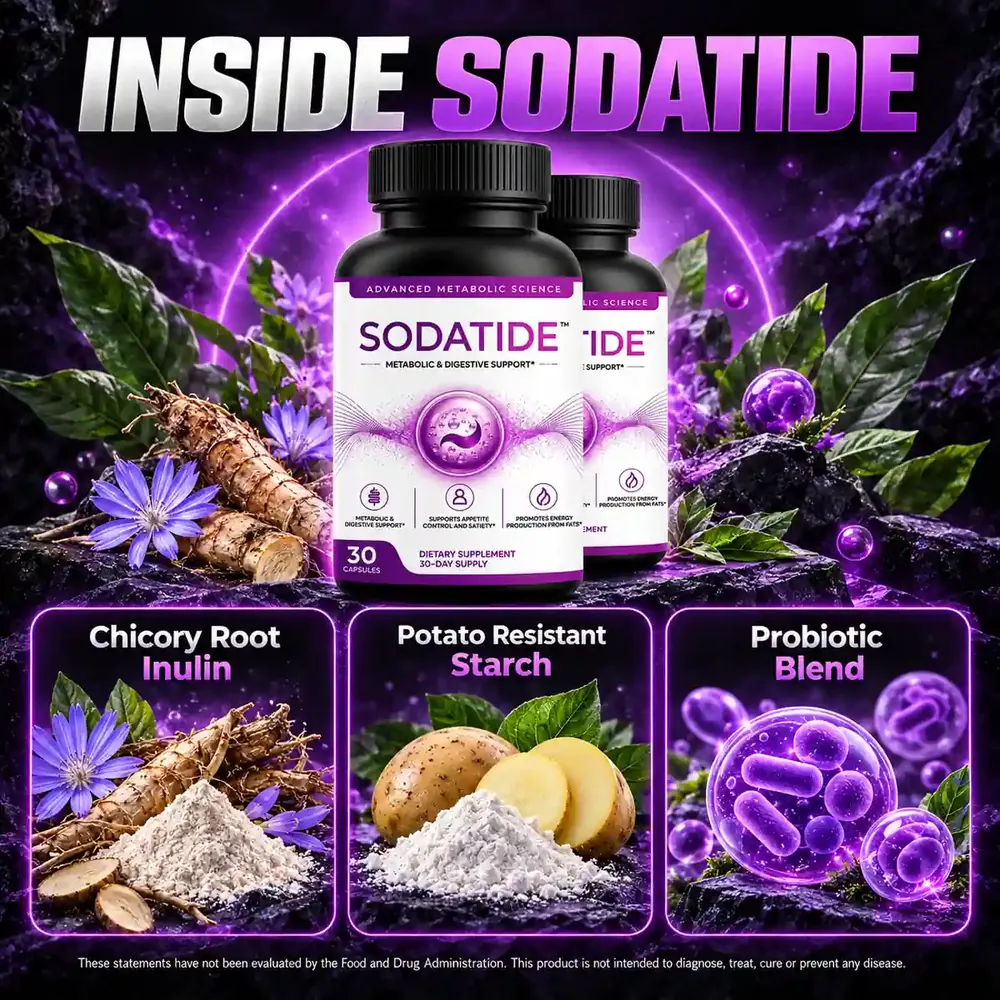
Sodatide contains three active ingredients in each capsule.
They are 211 mg of chicory root inulin, 100 mg of potato resistant starch and a 36 mg blend of B. infantis, C. butyricum and Akkermansia muciniphila. Hypromellose, microcrystalline cellulose, magnesium stearate and silica form the capsule.
Learn what these do in how Sodatide works.
Overview
What is inside one Sodatide capsule?
Each Sodatide capsule carries 347 mg of active ingredients. There are two fibers and one probiotic blend, plus four capsule helpers that carry no dose of their own.
The fibers do most of the weighing. Chicory root inulin and potato resistant starch add up to 311 mg. The three bacterial strains share the last 36 mg.
Label
The full Sodatide ingredients label in one table
Every line below is copied from the Supplement Facts box. Serving size is 1 capsule, and each bottle holds 30 servings. No ingredient has an established Daily Value, so each one carries the dagger symbol.
| Ingredient | Source on the label | Amount per capsule | Group | % Daily Value |
|---|---|---|---|---|
| Chicory Root Inulin | Cichorium intybus (root) | 211 mg | Prebiotic fiber | † Not established |
| Potato Resistant Starch | Potato [Resistant Starch] (tuber) | 100 mg | Resistant starch fiber | † Not established |
| Probiotic Blend | Bifidobacterium infantis, Clostridium butyricum, Akkermansia muciniphila | 36 mg | Three bacterial strains | † Not established |
| Hypromellose | Vegetarian capsule | Not listed by weight | Other ingredient | None |
| Microcrystalline cellulose | Other ingredient | Not listed by weight | Other ingredient | None |
| Magnesium stearate | Other ingredient | Not listed by weight | Other ingredient | None |
| Silica | Other ingredient | Not listed by weight | Other ingredient | None |
Want to see the printed panel itself? The Sodatide Supplement Facts page reads it line by line.
Inulin
Chicory root inulin: what does 211 mg do?
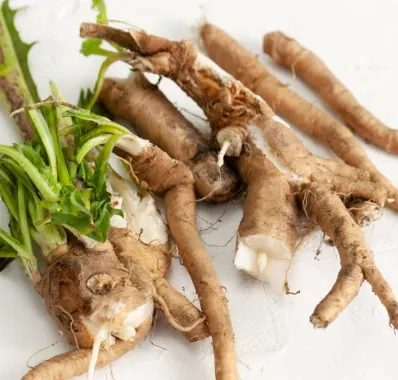
Chicory root inulin is a prebiotic fiber. Your own enzymes cannot break it down, so it reaches the colon, where bacteria ferment it (Gibson et al., 2017). Bifidobacteria are among the bacteria that use it well.
Human studies used far more than one capsule. In adults with mild constipation, 12 g a day for 4 weeks raised stool frequency from 3.0 to 4.0 a week (Micka et al., 2017). In a small fullness study, 16 g a day of a related fiber helped people eat about 5% fewer calories (Cani et al., 2006).
Tolerance data is reassuring. Native inulin was well tolerated up to 10 g in one test, with mild gas and bloating (Bonnema et al., 2010). At 211 mg, a capsule is far below that point.
- Label amount
- 211 mg
- Studied amounts
- 12 to 16 g a day
- Share
- About 1.3% to 1.8%
Resistant starch
Potato resistant starch: the smallest dose by share
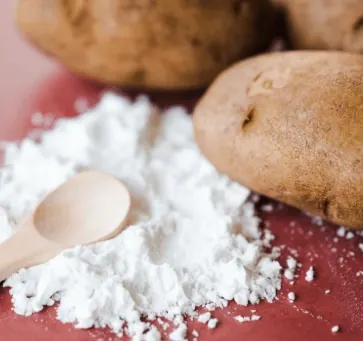
Resistant starch is starch that your body does not digest in the usual way. Like inulin, it travels to the colon and feeds bacteria there. Its fermentation is linked to butyrate, a fatty acid that colon cells use for fuel.
The potato studies used 30 g a day. Adults over 70 saw better glucose and insulin numbers after 12 weeks, while mid-age adults saw no change (Alfa et al., 2018). A 6-week trial in young adults found only one potato starch changed stool frequency, and all raised gas slightly (Dahl et al., 2016).
Studies with other starch sources point the same way. Resistant starch from high-amylose maize raised insulin sensitivity in men at 15 g and 30 g (Maki et al., 2012). Those doses are grams, not milligrams.
Blend
The 36 mg probiotic blend: why weight is not strength
The label lists three strains in one 36 mg blend. It does not give colony-forming units (CFU), and it does not split the 36 mg between the strains.
That matters because probiotic effects depend on the strain and the amount given (Hill et al., 2014). CFU is how the amount of live bacteria is usually shown. Listing it is voluntary in the US, and weight alone does not tell you how many live cells are inside (NIH Office of Dietary Supplements).
| Question | What the label says |
|---|---|
| Which species? | B. infantis, C. butyricum, A. muciniphila |
| Strain codes (like 35624)? | Not published |
| CFU per capsule? | Not published |
| Amount of each species? | Not published |
| Total blend weight? | 36 mg |
Strains
The three strains in Sodatide, one by one
Bifidobacterium infantis
This species is common in the gut of healthy infants and is also used in adult products. One well-known strain, 35624, eased pain, bloating and gas in 362 women with IBS at 100 million CFU a day for 4 weeks (Whorwell et al., 2006). The Sodatide label does not name a strain code, so we cannot say it holds that strain.
Clostridium butyricum
This bacterium makes butyrate. It forms spores, a hardy form that helps it survive handling. In a 4-week trial, more people with diarrhea-type IBS improved on about 1.9 billion CFU a day than on placebo (Sun et al., 2018).
Akkermansia muciniphila
This species lives in the mucus layer that lines the gut. In 32 overweight adults, 10 billion cells a day of pasteurized Akkermansia for 3 months were well tolerated and improved insulin sensitivity by about 29% versus placebo (Depommier et al., 2019). It is the newest and most talked-about strain in the blend.
For a longer read on the third strain, see Akkermansia muciniphila explained.
Other
What are the other ingredients for?
The four other ingredients hold the capsule together and help it run through the filling machine. They are common in many supplements and are not part of the dose.
Hypromellose
A plant-based cellulose that forms the shell. The label calls it a vegetarian capsule.
Microcrystalline cellulose
A refined plant fiber used as a filler. It bulks out the capsule so it fills evenly.
Magnesium stearate
A flow agent. It keeps powder from sticking to the machine during filling.
Silica
An anti-caking agent. It helps the powder stay loose and dry inside the capsule.
- No stimulants or caffeine listed
- No allergens declared on the label
- Made in the USA with globally sourced ingredients
Dose
How do Sodatide doses compare with the research?
Each bar shows the Sodatide amount against the dose used in human studies. The two fibers can be measured. The strains cannot, because the label gives no count.
Label: 211 mg. Studied: 12-16 g a day. (Micka et al., 2017) (Cani et al., 2006)
Label: 100 mg. Studied: 30 g a day. (Alfa et al., 2018) (Dahl et al., 2016)
Label: part of 36 mg, count not published. Studied: 10 billion cells a day. (Depommier et al., 2019)
Label: part of 36 mg, count not published. Studied: 100 million CFU a day. (Whorwell et al., 2006)
Label: part of 36 mg, count not published. Studied: about 1.9 billion CFU a day. (Sun et al., 2018)
The gap does not mean the ingredients are poor choices. It means the studies explain why they were picked, not what one capsule will do. We go deeper in Sodatide dose vs. research.
Verdict
Our take on the ingredient list
Pros
- Every fiber amount is printed in milligrams
- All three strains are named down to the species
- Sensible ingredients that fit the label claims
- Short list with a vegetarian shell
Cons
- Fiber doses are a small share of studied amounts
- No CFU count and no per-strain amounts
- No strain codes to match against studies
- No human study on this exact formula
Other effects and interactions are covered on the Sodatide side effects page.
Common questions
Sodatide ingredients FAQ
What are the main ingredients in Sodatide?
Chicory root inulin (211 mg), potato resistant starch (100 mg) and a 36 mg probiotic blend of B. infantis, C. butyricum and A. muciniphila.
What is the CFU count of the Sodatide probiotic blend?
It is not printed. The blend is listed as 36 mg, with no colony-forming unit count.
How much of each strain is in Sodatide?
Not published. The label gives one weight for the whole blend and does not split it between the three strains.
Is Sodatide vegetarian?
Yes, going by the label. The shell is hypromellose, listed as a vegetarian capsule, and it is made from plant cellulose.
Is there any caffeine in Sodatide?
No stimulants or caffeine are listed. The active ingredients are two fibers and three bacterial strains.
Is the fiber dose in Sodatide enough?
It is small. The inulin is about 1.3% to 1.8% of studied doses, and the resistant starch is about 0.3%. Food still supplies most of your daily fiber.
Which ingredient is the weakest in Sodatide?
Potato resistant starch, on paper. The 100 mg dose is about 0.3% of the 30 g a day used in potato starch studies.