The science, in plain words
How Does Sodatide Work? Fiber, Gut Bacteria and Fullness
Quick answer
Sodatide feeds your gut bacteria, which turn its two fibers into short-chain fatty acids.
Those acids, such as butyrate, feed the gut lining and help trigger fullness hormones. Three strains, including Akkermansia muciniphila, join the bacteria already there. Studies used much larger doses.
Next, see how long it may take.
Short
How does Sodatide work, in plain words?
Sodatide works through your gut bacteria rather than on your body directly. The two fibers are food for bacteria. The three strains are bacteria. Together they aim to shift what happens in the colon, where most gut bacteria live.
The idea has three links. Bacteria ferment fiber. Fermentation makes short-chain fatty acids. Those acids feed the gut lining and act as signals to the rest of the body.
- Chicory root inulin and potato resistant starch pass the stomach undigested
- Gut bacteria break them down in the colon
- That process makes acetate, propionate and butyrate
- Three named strains join the bacteria already in your gut
Path
What happens after you swallow a capsule?
Follow one capsule from the glass of water to the colon. Each stage below matches a part of the formula.
The shell opens
The hypromellose capsule dissolves in the stomach and releases the powder inside.
Fiber passes through
Your own enzymes cannot split inulin or resistant starch, so both move through the small intestine mostly intact (Gibson et al., 2017).
Bacteria get to work
In the colon, bacteria ferment the fibers. Bifidobacteria are among the strongest users of inulin.
Acids are released
Fermentation makes short-chain fatty acids. Colon cells take up butyrate as fuel, and the others enter the blood.
Signals go out
Short-chain fatty acids help trigger gut hormones tied to fullness and blood sugar control.
Scfa
What are short-chain fatty acids, and why do they matter?

Short-chain fatty acids are small molecules that gut bacteria make from fiber. Acetate, propionate and butyrate lead the list. Your body cannot make much of them without bacteria doing the work.
A prebiotic is defined by this kind of effect: a substance that gut microbes use selectively, with a health benefit to the host (Gibson et al., 2017). Inulin is one of the best-studied examples.
These acids help keep the gut lining healthy. They also talk to cells that release gut hormones. That second role links fiber to appetite and metabolism.
Fullness
How is fiber linked to fullness hormones?
Two gut hormones matter most here. Ghrelin rises when you are hungry. Peptide YY (PYY) rises after a meal and helps you feel full.
In a 12-week trial, adults who took 21 g of oligofructose a day had lower ghrelin, higher PYY and ate fewer calories (Parnell & Reimer, 2009). In a shorter study, 16 g a day for 2 weeks made people feel fuller at breakfast and dinner (Cani et al., 2006). Oligofructose is a shorter form of the same inulin-type fiber.
| Hormone | What it does | Direction seen with inulin-type fiber |
|---|---|---|
| Ghrelin | Signals hunger before meals | Down (Parnell & Reimer, 2009) |
| Peptide YY (PYY) | Signals fullness after meals | Up (Parnell & Reimer, 2009) |
| Calorie intake | Result of both signals | Lower, about 5% a day in one study (Cani et al., 2006) |
This is the science behind the label claim on appetite. How each claim is read is on the Sodatide benefits page.
Akkermansia
What does Akkermansia do in the mucus layer?
Your gut is lined with a layer of mucus. It keeps bacteria at a safe distance from the cells beneath. Akkermansia muciniphila lives in that layer and feeds on the mucus itself.
That may sound odd for a helpful microbe. The gut renews its mucus all the time, and Akkermansia is a normal resident of many healthy guts. Its links to metabolic health are why researchers tested it as a supplement in adults with excess weight (Depommier et al., 2019).
- Where it lives
- The mucus layer lining the gut
- What it eats
- Mucus proteins made by your own gut
- Key human study
- 10 billion cells a day for 3 months in 32 overweight adults (Depommier et al., 2019)
- What changed
- Insulin sensitivity improved by about 29% with the pasteurized form versus placebo
There is a longer read in Akkermansia muciniphila explained.
Butyrate
Where does butyrate come from?
Butyrate is the short-chain fatty acid that colon cells like best. It is their main fuel. Several parts of the formula point toward it, each in a different way.
Clostridium butyricum
Named for the butyrate it makes. About 1.9 billion CFU a day helped more people with diarrhea-type IBS than placebo (Sun et al., 2018).
Resistant starch
A favored fuel for butyrate makers. At 40 g a day for 12 weeks, it improved insulin sensitivity in insulin-resistant adults (Johnston et al., 2010).
Bifidobacterium infantis
Ferments inulin into acids that other gut bacteria can build on. One strain eased bloating in women with IBS (Whorwell et al., 2006).
Synbiotic
Why pair fiber with probiotics?
Products that combine prebiotic fiber with live bacteria are called synbiotics. The logic is simple: the fiber is food, and the strains are the eaters. Sodatide is built on that pairing.
The closest human study is a 12-week trial in 76 adults with type 2 diabetes (Perraudeau et al., 2020). It tested a formula with Akkermansia, C. butyricum, B. infantis and inulin, and after-meal glucose improved.
Dose
How do the study doses compare with one capsule?
Every study above used far more than one Sodatide capsule holds. The fiber studies used grams a day. The strain studies used counted doses of millions or billions of live cells.
| Ingredient | In Sodatide | In the study | Source |
|---|---|---|---|
| Inulin-type fiber | 211 mg | 12 to 21 g a day | (Micka et al., 2017) (Parnell & Reimer, 2009) |
| Resistant starch | 100 mg | 30 to 40 g a day | (Alfa et al., 2018) (Johnston et al., 2010) |
| Akkermansia | Part of 36 mg | 10 billion cells a day | (Depommier et al., 2019) |
| C. butyricum | Part of 36 mg | About 1.9 billion CFU a day | (Sun et al., 2018) |
| B. infantis | Part of 36 mg | 100 million CFU a day | (Whorwell et al., 2006) |
The label gives no CFU count, so the strain doses cannot be compared directly (NIH Office of Dietary Supplements). The studies show how each ingredient can work. They do not measure what one small capsule does. For the full math, see Sodatide dose vs. research.
Claims
How does the mechanism connect to the label claims?
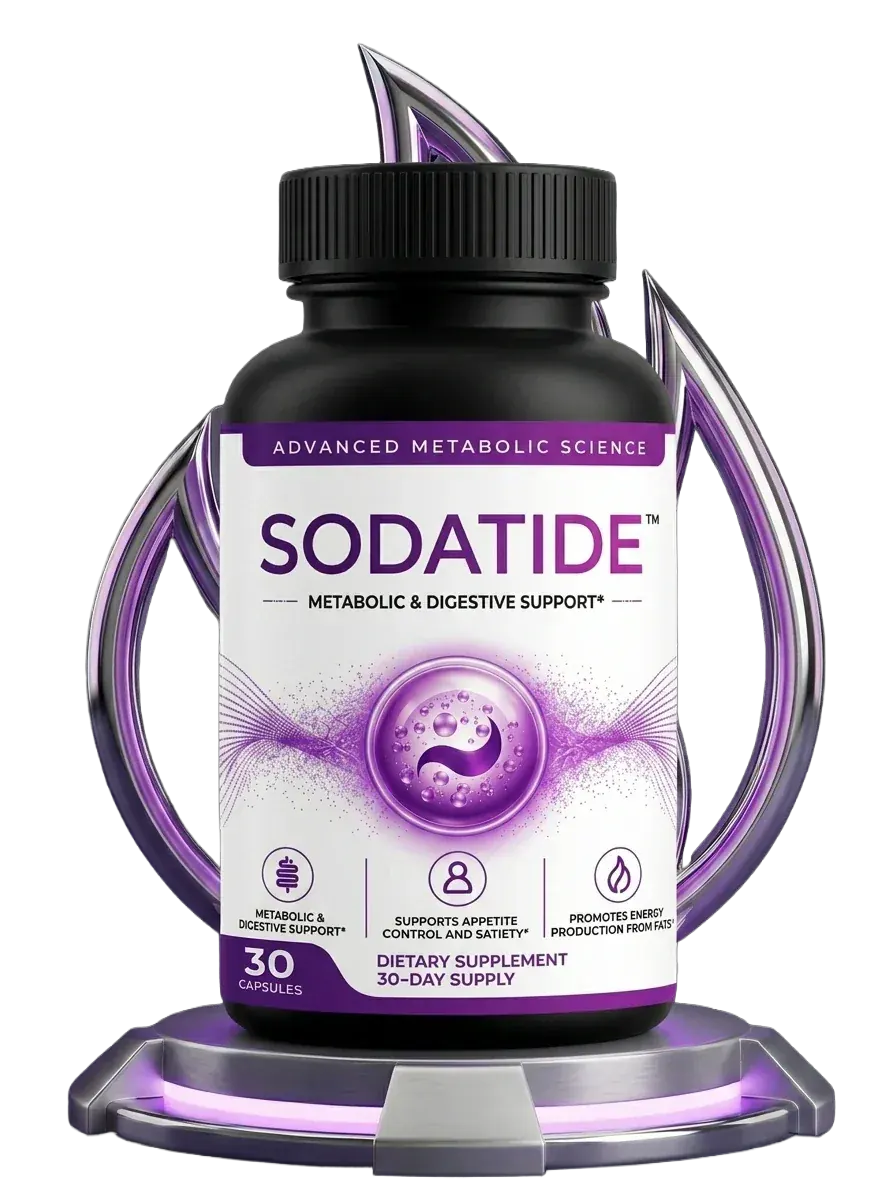
There are three claims on the Sodatide label. Each one lines up with a part of the gut process described above. The table shows the link and the kind of evidence behind it.
| Label claim | Mechanism behind it | Evidence in people |
|---|---|---|
| Metabolic & Digestive Support | Fiber feeds gut bacteria; strains add to the mix | Inulin made stools more regular at 12 g a day (Micka et al., 2017) |
| Supports Appetite Control And Satiety | Fermentation raises fullness hormones such as PYY | Lower ghrelin and higher PYY at 21 g a day (Parnell & Reimer, 2009) |
| Promotes Energy Production From Fats | Short-chain fatty acids take part in how the body handles energy | No study on this formula; the label cites none |
The first two claims have direct human studies behind their ingredients. The third rests on the general biology of short-chain fatty acids rather than a trial.
Limits
What Sodatide cannot do
Knowing the mechanism also shows its limits. Sodatide works slowly, through bacteria, and its effects depend on your diet and your gut.
- It does not act like a drug on hormones or blood sugar.
- It does not burn fat or block calories.
- It cannot out-feed a low-fiber diet; food brings grams, the capsule brings milligrams.
- It is not designed to diagnose, treat, cure or prevent any disease.
How long the process may take to show is covered on how long Sodatide takes to work.
Common questions
How Sodatide works: quick questions
Is Sodatide a prebiotic or a probiotic?
Both. It pairs two prebiotic fibers with three probiotic strains, which makes it a synbiotic.
Does Sodatide work like a GLP-1 drug?
No. Fiber fermentation is linked to natural gut hormones in studies, but the capsule is a supplement, not a medicine, and it has no drug-like action.
Has Sodatide itself been studied?
No published human study has tested the exact formula. The studies cited here tested its ingredients, mostly at much larger doses.
What is butyrate?
A short-chain fatty acid made when gut bacteria ferment fiber. Colon cells use it as their main fuel.