Sodatide Blog
Why Sodatide’s Label Reads “Potato (Tuber)”: the Botanical Part-of-Plant Rule
Quick answer
On Sodatide’s Supplement Facts panel, the second active ingredient is printed as “Potato [Resistant Starch] (tuber), 100 mg.” That parenthetical is not decoration. Under 21 CFR 101.4(h), a botanical dietary ingredient has to name the part of the plant it comes from, and potato starch is derived from a tuber, the swollen underground stem potatoes grow from, not a root, leaf or seed. The chicory ingredient one line up gets the same treatment, printed as “(root).”
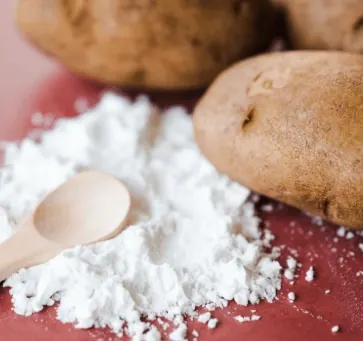
Read the Sodatide Supplement Facts box closely and two of its three active ingredient lines carry a small parenthetical most readers skip past: “(root)” after the chicory inulin line, and “(tuber)” after the potato resistant starch line. Those single words are not filler copy. They are the label satisfying a specific federal requirement to name which part of the plant a botanical ingredient actually comes from, and they are worth fourteen hundred words on their own because the rule behind them is easy to misunderstand.
The rule
What does 21 CFR 101.4(h) actually require?
The requirement behind “(tuber)” is short, specific, and aimed at a real labeling problem: botanical names alone don’t tell you which part of the plant was used.
The regulation also specifies that the plant part has to be named in plain English, not Latin, and the requirement applies across botanical dietary ingredients generally, with a narrow carve-out for algae, where a part-of-plant designation doesn’t meaningfully apply. The underlying goal is straightforward: “potato” by itself could in principle mean the starchy tuber, the leaves, or even the toxic above-ground parts of the plant. Naming the part removes that ambiguity from the label itself, rather than leaving it to the buyer’s assumption.
Tuber, not root
Why “tuber” specifically, and not “root”?
The two words get used loosely in everyday speech. Botanically, and on this label, they describe two different structures.
What a tuber is
A tuber is a swollen underground stem, not a root. A potato plant’s true roots are thin and fibrous; the part people eat, and the part Sodatide’s resistant starch is extracted from, is the tuber, which stores starch for the plant and happens to grow underground.
What a root is
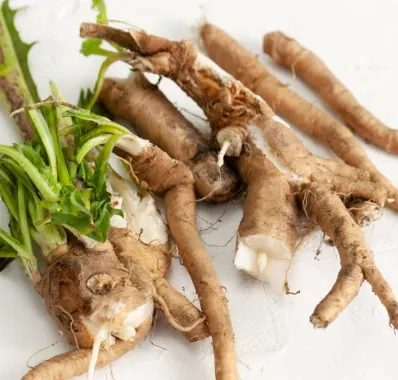
A root, by contrast, is the organ that anchors the plant and draws up water and nutrients. Chicory root, the source of the inulin on this same label, genuinely is a root in the botanical sense, which is why its label line correctly reads “(root)” rather than “(tuber).”
The label is not using these words interchangeably. It is distinguishing two different plant structures correctly, on two different ingredient lines, which is exactly what 21 CFR 101.4(h) is designed to force a label to do.
The chicory line
The same rule, applied two lines up, on the chicory line
“(tuber)” is not a one-off. The line directly above it on the same panel follows the identical rule.
| Printed ingredient line | Plant part named | Botanically accurate? |
|---|---|---|
| Chicory Root Inulin — Cichorium intybus (root), 211 mg | Root | Yes, inulin is extracted from the chicory plant’s actual root |
| Potato [Resistant Starch] (tuber), 100 mg | Tuber | Yes, resistant starch is extracted from the potato tuber |
| Probiotic Blend: B. infantis, C. butyricum, A. muciniphila, 36 mg | Not applicable | Correctly omitted; bacterial strains aren’t plant-derived, so 101.4(h) doesn’t apply to this line |
That third row matters for understanding the rule’s actual scope. 101.4(h) governs botanical ingredients specifically. It has nothing to say about the probiotic blend, because bacterial strains are not plant material, and the label correctly does not apply a part-of-plant tag to a line where the concept would not make sense. The full ingredient table, including source names and amounts for every line, is on the ingredients page.
Where it fits
Where does this rule sit inside the Supplement Facts regulation?
101.4(h) is written as a general food-labeling rule, but it reaches Sodatide’s Supplement Facts box through a specific cross-reference.
21 CFR 101.36(d) governs how source ingredients are identified inside a dietary supplement’s Supplement Facts panel, and it requires that they “be identified in accordance with §101.4,” meaning listed by common or usual name, with botanicals specifying the plant part the ingredient is derived from. In practical terms, the general part-of-plant rule written for food ingredient lists gets pulled directly into the dietary supplement panel by that cross-reference, which is why the requirement shows up inside the Supplement Facts box itself rather than in a separate ingredients statement elsewhere on the bottle.
That is also why this sits alongside the panel-format questions covered in why the facts panel appears as both a photo and a text table and front panel vs. side panel label law. All three rules reach the same physical box on the same side panel; 101.4(h) just governs one specific detail inside it, the wording of the source line itself.
What it tells you
What does a part-of-plant tag actually tell a buyer?
It is a narrow, identity-focused disclosure, worth being precise about what it covers and what it leaves untouched.
- What it confirms
- Which structure of the plant the ingredient was extracted from, so “potato” cannot be read as meaning the leaves or any other part
- What it does not confirm
- Processing method, purity, how much resistant starch the extraction actually yields, or anything about dose or effect
- Why it still matters
- Botanical identity errors are a real, documented category of supplement mislabeling; naming the plant part is one concrete check against that specific error
Put another way, a part-of-plant tag is a narrow identity check, not a quality score. It confirms the label is describing the right piece of the right plant, the same kind of check a careful reader would want on any botanical ingredient, whether it is a familiar kitchen vegetable like potato or a less familiar botanical. It does not, and was never meant to, stand in for the separate questions of potency, purity or dose that a buyer might also want answered.
What’s absent
What does this rule not require, that some readers expect?
A label can only be judged against what it is actually required to say. 101.4(h) has a narrow job, and several related facts simply fall outside it.
- It does not require naming the potato variety or growing region
- It does not require disclosing the extraction or processing method used to make the resistant starch
- It does not require a certificate of analysis confirming the tuber source, which is a separate quality-testing question covered on the testing and quality page
- It says nothing about dose, and is not a substitute for comparing the 100 mg amount against studied doses, which Sodatide doses vs. research covers separately
None of those gaps are violations. They are simply outside what this particular rule was written to require, which is the common mistake to avoid when reading any single labeling requirement: treating it as a complete safety or quality disclosure rather than the one narrow thing it actually governs. A part-of-plant tag and a quality test are two different kinds of evidence, governed by two different parts of the regulatory system, and conflating them tends to make a compliant label look more suspicious, or a non-compliant one look more reassuring, than the facts support.
Our take
Our verdict: does “(tuber)” matter?
In isolation, no single reader’s buying decision turns on one parenthetical word. What it demonstrates is more useful than the word itself: Sodatide’s label is correctly applying a specific, easy-to-overlook federal rule, 21 CFR 101.4(h), on two separate ingredient lines, naming a root correctly as a root and a tuber correctly as a tuber, and correctly leaving the designation off the one line where it does not apply.
That is a small, checkable example of a label doing what the regulation asks, which is exactly the kind of line-by-line reading this site tries to do across the whole panel. It is also a useful habit to carry to any other supplement label, not just this one: when a botanical ingredient line includes a word like “root,” “leaf,” “seed,” “bulb” or “tuber” in parentheses, that is 21 CFR 101.4(h) at work, not marketing flavor text, and it is worth a second look rather than a skim. See every line of the printed label, with the same care, on the Supplement Facts page.
Common questions
The “(tuber)” rule, common questions
Is a part-of-plant tag like “(tuber)” required for every botanical ingredient?
21 CFR 101.4(h) requires a part-of-plant declaration for botanical dietary ingredients generally, with a narrow carve-out for algae. A potato-derived starch used as an active ingredient falls under that rule, which is why it is named here.
Would the label be wrong if it read “Potato (root)” instead of “Potato (tuber)”?
Yes, botanically. A potato plant’s true roots are the thin, fibrous structures that anchor it. The starch-storing structure people eat, and that resistant starch is extracted from, is the tuber, a modified underground stem, a different structure from a root.
Does the same part-of-plant rule apply to the three probiotic strains?
No. 101.4(h) governs botanical, plant-derived ingredients. Bacterial strains are not plant material, so a part-of-plant tag does not apply to that line, and the label correctly leaves one off.
Does naming the plant part confirm how much resistant starch the potato actually yields?
No. The part-of-plant tag is strictly an identity declaration. It says nothing about extraction method, concentration or the 100 mg amount itself, which Sodatide doses vs. research covers separately.
Is chicory root’s “(root)” declaration governed by the same regulation?
Yes, identically. Both the chicory inulin line and the potato resistant starch line are botanical ingredients under 21 CFR 101.4(h), each correctly naming its own distinct plant part.
Sources
Sources
We opened and checked each source before citing it. Links go to the federal regulation text.
- 21 CFR §101.4, Dietary ingredient labeling, subsection (h), Botanical dietary ingredients. Open source
- 21 CFR §101.36(d), Nutrition labeling of dietary supplements. Open source
- Sodatidenow. Sodatide ingredients label transcription. Open source