Sodatide Blog
Prebiotic, Probiotic or Synbiotic? How to Read a Gut Supplement Label
Quick answer
A prebiotic is fiber that feeds gut bacteria, a probiotic is the live bacteria, and a synbiotic combines both. Sodatide is a synbiotic. Check fiber in grams, a CFU count, full strain names and storage. Sodatide prints its fiber (311 mg) and three species, but no CFU count or strain codes.

Gut supplement labels use a small set of words and numbers. Once you know what each one means, you can size up a bottle in about two minutes. We use the Sodatide label as the example, good parts and gaps included.
Three words
What is the difference between a prebiotic, a probiotic and a synbiotic?
A prebiotic feeds gut bacteria, a probiotic is the bacteria, and a synbiotic is both in one product. Experts define a prebiotic as a substrate that gut microbes use selectively and that gives a health benefit (Gibson et al., 2017). A probiotic is a live microbe that helps the host when given in adequate amounts (Hill et al., 2014).
| Type | What it is | Common examples | How the dose is shown | In Sodatide |
|---|---|---|---|---|
| Prebiotic | Fiber that gut bacteria ferment | Inulin, oligofructose, resistant starch | Grams or milligrams | 211 mg inulin, 100 mg potato starch |
| Probiotic | Live bacteria or yeast | Bifidobacterium, Lactobacillus strains | CFU, the count of live cells | Three species in a 36 mg blend |
| Synbiotic | A prebiotic and a probiotic together | Fiber plus strains in one capsule or powder | Both of the above | Sodatide is this type |
The words matter because each one changes how you judge the dose. Fiber is weighed. Bacteria are counted. A synbiotic label should do both.
Panel
How do you read a Supplement Facts panel on a gut product?
Start at the top of the box and work down. Serving size and servings per container come first, then each ingredient with its amount, then anything in a blend.
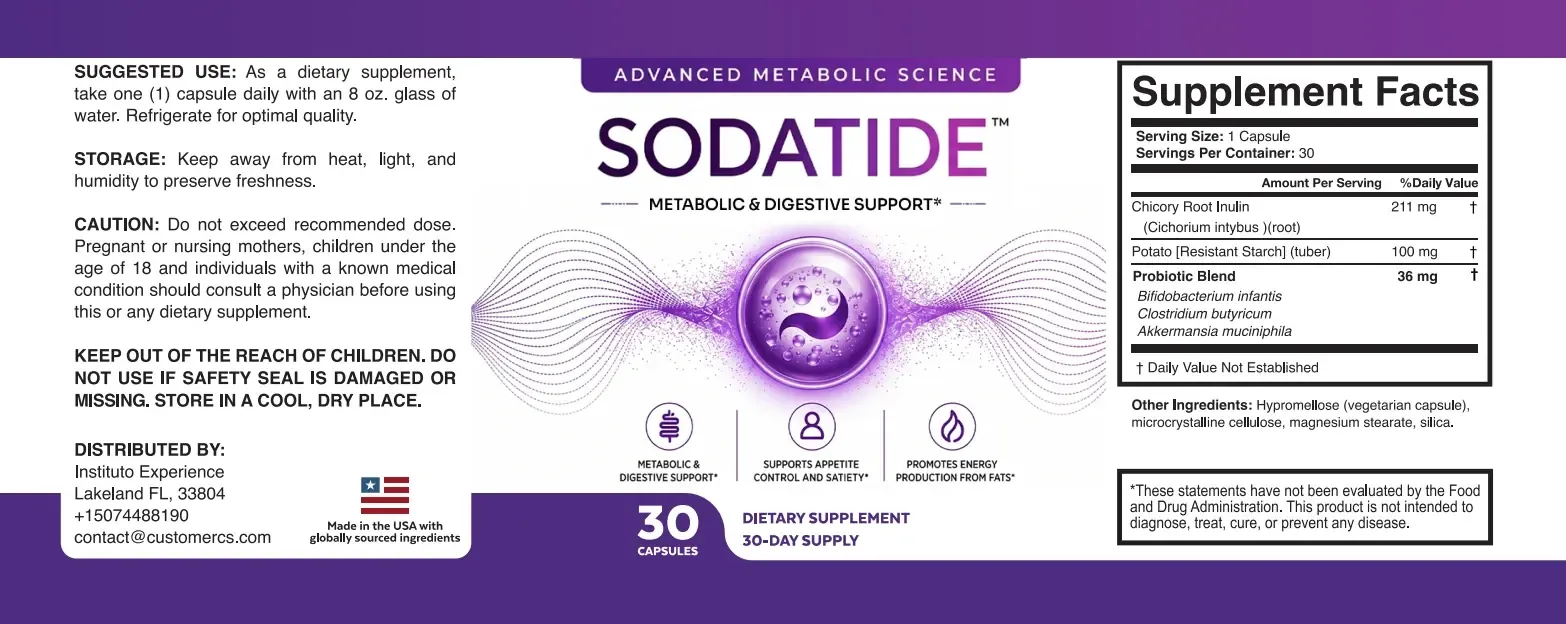
Serving size
How many capsules make one dose. On Sodatide it is 1 capsule, with 30 servings in the bottle.
Each named ingredient
Look for an amount beside every item. Inulin at 211 mg and potato starch at 100 mg are printed clearly.
Blends
A blend shows one weight for several items. The 36 mg probiotic blend lists three species but not their split.
Other ingredients
The capsule and helpers. Here that is hypromellose, microcrystalline cellulose, magnesium stearate and silica.
A line-by-line tour of this box is on the Sodatide Supplement Facts page.
Cfu
What is a CFU, and why does it matter on a probiotic label?
CFU stands for colony-forming units. It is the standard way to count live bacteria that can grow. In the US, listing CFU on a label is voluntary, and the benefit depends on both strain and amount (NIH Office of Dietary Supplements).
Weight vs count
A weight in milligrams tells you how much powder is in the blend. That powder can include carrier and dead cells. Two blends with the same weight can hold very different numbers of live bacteria.
When the count is measured
A strong label says the count is good through the best-by date, not just at the factory. Sodatide prints no CFU and no best-by date, so neither can be checked.
Strain names
How should strain names look on a label?
A full strain name has three parts: genus, species and a strain code. Effects belong to specific strains, so the code is what links a product to a study (Hill et al., 2014).
| Part | Example | On the Sodatide label |
|---|---|---|
| Genus | Bifidobacterium | Printed |
| Species | infantis | Printed |
| Strain code | 35624, the strain tested in one IBS study (Whorwell et al., 2006) | Not published |
Sodatide names Bifidobacterium infantis, Clostridium butyricum and Akkermansia muciniphila at the species level. That is better than a vague "probiotic blend" with no names. It still stops one step short of a code you could match to a trial.
The Akkermansia trials are covered in Akkermansia muciniphila explained.
Read the label and like what you see? Sodatide comes with a 60-day refund window.
Prices from $49 a bottle. Free US shipping on 3 and 6 bottles.
Fiber grams
How much fiber should a label show?
Check the fiber in grams, because that is how food and studies measure it. Sodatide has 211 mg of inulin plus 100 mg of potato starch. That adds up to 311 mg, or 0.311 grams.

- Fiber per capsule
- 0.311 g
- Usual adult fiber target
- 25 to 38 g a day, mostly from food
- Inulin in studies
- 12 to 16 g a day (Micka et al., 2017) (Cani et al., 2006)
- Potato starch in studies
- 30 g a day (Alfa et al., 2018)
We work through each gap in Sodatide doses vs research.
Storage
What do the storage lines on a probiotic label tell you?
Storage lines show how the maker wants the bacteria kept. Heat, light and moisture can lower the count over time, so a cold or dry instruction is a clue that the product has live cells.
| Source | What it says |
|---|---|
| Label, suggested use | Refrigerate for optimal quality. |
| Label, storage | Keep away from heat, light, and humidity to preserve freshness. |
| Label, warnings | Store in a cool, dry place. |
| Brand tip | Refrigerate after opening to preserve the potency of the probiotics. |
The label and the brand agree on the main point: keep the bottle cool. When wording differs, we follow the label and treat the brand line as a tip.
Worked example
Worked example: how does the Sodatide label score, line by line?
Here is the whole method applied to one real bottle. Sodatide does well on clarity for fiber and names, and falls short on the counts that let you compare.
| What to check | What a strong label shows | What Sodatide shows | Verdict |
|---|---|---|---|
| Product type | Says prebiotic, probiotic or both | Fiber plus three species | Clear |
| Fiber amounts | Each fiber by weight | 211 mg and 100 mg | Clear, but small |
| Strain names | Genus, species and code | Genus and species only | Partial |
| Live count | CFU per serving | Not published | Missing |
| Count guarantee | Good through a best-by date | No date published | Missing |
| Storage | A clear instruction | Refrigerate, cool and dry | Clear |
| Claims | Structure-function wording with the FDA note | Three claims with asterisks | Clear |
Checklist
What is a quick label checklist you can use on any bottle?
You can run these six checks on any gut product in a store or online. If a box stays empty, ask the seller before you buy.
- Is it a prebiotic, a probiotic or both?
- Is every fiber listed in grams or milligrams?
- Does each strain have a genus, species and strain code?
- Is there a CFU count, good through a best-by date?
- Does the storage line match how you will keep it?
- Do the claims stay within structure-function wording, with the FDA note?

Some buyers should check with a doctor before any probiotic. That includes people with a weakened immune system, anyone on immune-suppressing drugs or antibiotics, and people who are pregnant or nursing.
For a wider buying guide, see how to choose a gut health supplement.
Sources
Sources
Each source was opened and checked before we cited it.
- Gibson GR, et al, Nature Reviews Gastroenterology & Hepatology 2017;14:491-502: “Expert consensus document: The International Scientific Association for Probiotics and Prebiotics (ISAPP) consensus statement on the definition and scope of prebiotics”. Open source
- Hill C, et al, Nature Reviews Gastroenterology & Hepatology 2014;11:506-514: “Expert consensus document: The International Scientific Association for Probiotics and Prebiotics consensus statement on the scope and appropriate use of the term probiotic”. Open source
- National Institutes of Health, Office of Dietary Supplements. Probiotics: Fact Sheet for Health Professionals. Updated March 25, 2025. Open source
- Whorwell PJ, et al, American Journal of Gastroenterology 2006;101(7):1581-1590: “Efficacy of an encapsulated probiotic Bifidobacterium infantis 35624 in women with irritable bowel syndrome”. Open source
- Micka A, Siepelmeyer A, Holz A, Theis S, Schön C, International Journal of Food Sciences and Nutrition 2017;68(1):82-89: “Effect of consumption of chicory inulin on bowel function in healthy subjects with constipation: a randomized, double-blind, placebo-controlled trial”. Open source
- Cani PD, et al, European Journal of Clinical Nutrition 2006;60:567-572: “Oligofructose promotes satiety in healthy human: a pilot study”. Open source
- Alfa MJ, Strang D, Tappia PS, et al, Frontiers in Medicine 2018;4:260: “A randomized placebo controlled clinical trial to determine the impact of digestion resistant starch MSPrebiotic on glucose, insulin, and insulin resistance in elderly and mid-age adults”. Open source